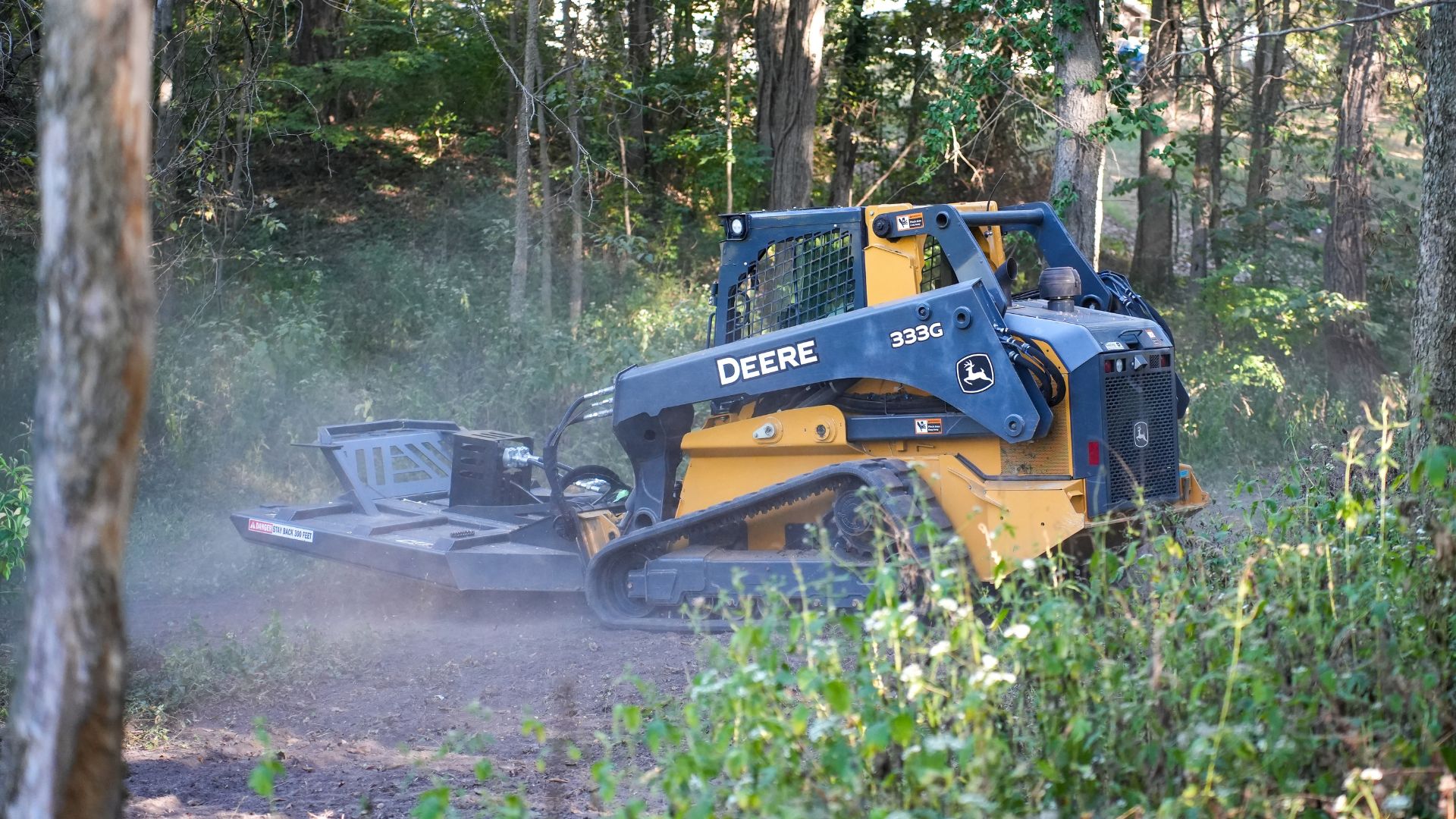
Features to retain
A useful clearing plan identifies the parts of the landscape that still have a job to do.
- Selected trees and natural screening
- Access routes and existing fences
- Areas intentionally left outside the work

Open overgrown ground with a vegetation-clearing approach that processes material on site.
Dense brush can make a useful piece of land difficult to enter, see across or maintain. Forestry mulching processes brush and suitable woody vegetation into smaller material at the work site. It is a clearing approach to consider when the goal is to open an area and retain processed vegetation on the ground rather than arrange the project around removing every piece of material.
Tines Down Property Services offers forestry mulching for residential, commercial and agricultural properties in Girard, Springfield and our Central Illinois service area. The vegetation, access and intended use determine whether mulching fits a particular section. A wooded edge, an overgrown opening and a future work area can call for different limits even on the same parcel.
Start by describing what you want to reach or use afterward. A clearing result suitable for access through a property may be different from the ground condition needed for a future lawn, building or other improvement.
Compare with broader land clearingThese are planning distinctions, not preset packages or a promise that every method suits every site.
Scroll horizontally to compare all options.
| Feature | Mulching focus | Material-removal focus |
|---|---|---|
| Vegetation after clearing | Processes suitable vegetation into smaller material on site. | Addresses where cut or removed material will be placed or taken. |
| Desired surface | Discuss the amount and condition of material left on the ground. | Define cleanup and the condition required for the next use. |
| Next phase | Confirm whether retained material fits future access or upkeep. | Identify any separate excavation, grading or construction needs. |
Mulched ground is not the same as bare, graded soil. Processed material may remain on the surface, and treatment of roots or stumps is a separate question. If the next step requires a particular soil surface or excavation, explain that goal before the clearing scope is decided.
Trees, boundary plantings and other features you want to keep should be identified alongside the removal areas. The condition and distribution of vegetation matter as much as the outline on a map. Mulching does not imply that every tree is suitable for removal; our exclusion of large-scale logging and hazardous tree work requiring specialized arborist or crane services still applies.
Think about future upkeep as well as the immediate opening. Clearing vegetation does not establish that a site will stay clear indefinitely. Discuss how the treated space will be used and maintained so the initial work supports that longer-term purpose.
Explore focused brush clearingThe boundary of the work and the future of the opening deserve separate attention.
A useful clearing plan identifies the parts of the landscape that still have a job to do.
The surface after mulching should be discussed in relation to how the land will be used.
Feedback about working with Tines Down Property Services.
Customer reviews will appear here when our review feed is connected.
No. Reducing vegetation above ground and removing below-ground material are different scopes. Describe the finish you need, especially if the site will later be excavated, graded or used for construction.
Processing vegetation on site is the defining focus of mulching. The expected remaining material and any additional cleanup should be agreed for your project rather than assumed from the service name.
Do not treat a clearing visit as a permanent guarantee against regrowth. Future maintenance depends on the vegetation and how the space is used. Explain whether you want an access opening, a maintained area or another end use.
Yes, you can request a defined work area rather than the entire parcel. Identify retained trees, boundary features and the route into the section you want opened; suitability still depends on the site.
No single method fits every property. Vegetation size, density, access, slope and ground conditions affect suitability. Large-scale logging and specialized hazardous tree removal remain outside our offering.
Provide the location, approximate treatment area, representative photographs and desired finished condition. Total acreage alone does not describe vegetation density, access or material-handling needs.
Share your property location, the work you need and the result you have in mind. Photos, plans and information about the existing conditions can help explain your project.
Online inquiries will be available here once the form is connected.
For now, call or email us with your property location and the project you have in mind.
Call (217) 299-4956Email Tines Down